Health is wealth, eat well to live well.
Join my community and receive my free ebook! Subscribe now >>
The Four Principles Of
Exercise And Blood Pressure
Exercise and blood pressure goes hand in hand in lowering high blood pressure and weight loss. Exercising is one of the most powerful non-drug remedies for the prevention and treatment of hypertension that you can do for your own health and well-being. Below is a free printable fitness chart to help you track your progress.
Although it may seem self-explanatory the four principles of exercise are intensity, frequency, mode and duration. Let me explain:
- Intensity refers to the difficulty of a particular type of training.
- Frequency refers to how often one exercise.
- Mode is the type of exercise you have chosen.
- And, duration is simply the total time of exercise.
Note that you don't have to join a gym, train for a 10K to feel healthier inside and out. Let my daily activity fitness chart below guides you to transformation. The four weeks chart is designed to supercharge your strolls and reap the benefits of a slimmer, fitter and happier you in one month.
It is vital to know that before starting any exercise program, you are to get your doctor's permission.
Aerobic Training Exercise And Blood Pressure Control
To achieve cardiovascular benefits aerobic training is a must for blood pressure lowering. This type of physical activity uses the large muscle groups of your body for prolonged periods of time.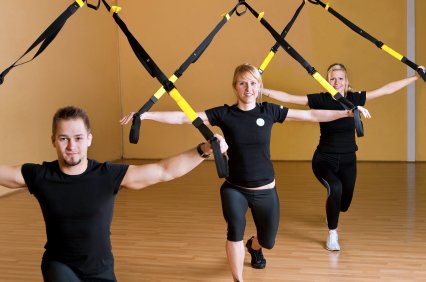
You must have the appropriate intensity, frequency, mode and duration of exercise to achieve cardiovascular benefits. 70% of your maximal predicted heart rate is required to ensure good cardiovascular benefits.
To determine what your maximum heart rate is minus your age from 220. Say you are a 40 year old with a maximum heart rate of 220 minus 40 = 180. 70% of 180 is 126. So for say a 40 year old to achieve cardiovascular benefits, he/she must exercise at a steady heart rate of approximately 126 beats per minute.

 and monitor your heart rate and activities.
Weight loss is practically assured if aerobic training is done four or five times a week for at least 60 minutes. Aerobic exercises includes walking, jogging, running, bicycling, stair climbing, cross-country skiing are some of the best exercise you can do for your health.
Mix up the different exercises so that you do not get bored. An exerciser's heart becomes stronger and more efficient therefore delivering more blood, oxygen and nutrients to the brain, muscles and other vital organs.
The trade-off from exercising is both systolic and diastolic blood pressure usually decrease with exercise.
Resistance Or Weight Training Exercising
Weight training improves your strength and endurance. The intensity of weight training is measured by the amount of weight lifted.
A schedule of two to three exercise sessions a week lasting approximately thirty minutes to one hour is appropriate for individuals just starting a weight training routine. But, remember to allow your muscles to recover, at least a day, completely between training.
The benefits of weight training are not only for the young and healthy, but older people can benefit dramatically from a resistance training program. Research has shown that older individuals who do resistance training are usually stronger, healthier and less depressed.
So it is never too late to start a properly supervised weight training program.
Flexibility Exercises
We all tend to underestimate the benefit of flexibility in our exercise and blood pressure program. Without flexibility training you are prone to develop musculoskeletal problems.
Low back pains that afflicts millions of people is usually the results from musculoskeletal disorder. If you practice flexibility techniques, like stretching, on a regular basis, we would be less prone to back problems.
Whenever you do spinning, or any strenuous exercise program you should always end your exercise and blood pressure program with a couple of Pilates or yoga moves.
My muscles tend to ache less.
Again varying your exercises will keep it interesting and exciting, thus increasing the likelihood that you will keep up the exercise regimen.
Exercise and blood pressure translates into a lower risk of future heart attacks, strokes and kidney damage due to high blood pressure. And of course, you will look and feel better, and probably live longer after getting hooked on exercise.
Plan To Exercise
Regular exercise is essential to getting and staying fit. To ensure you stay on track, print out our free fitness chart below and put it in a place where you'll be reminded to get up and move everyday.
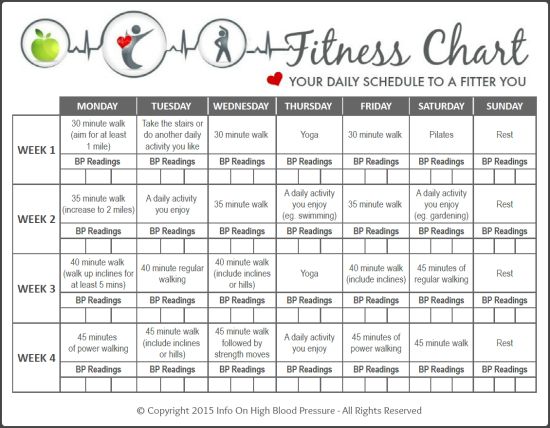
We have also included a version of the chart to track your daily BP readings so you'll have a record of how your fitness schedule is helping to improve your health.
** Note: Do not record BP readings immediately after exercise. Record them at your usual time each day.
Printable Fitness Chart
Fill in the form below to get your free printable charts.
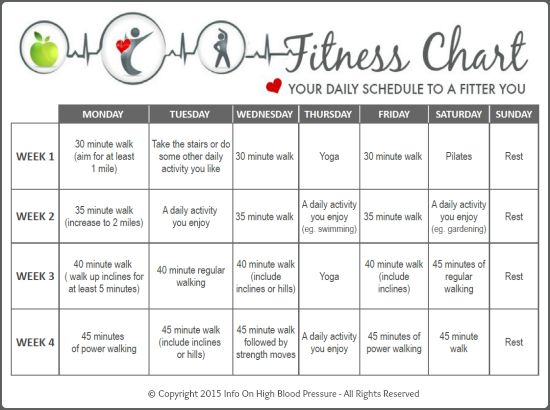
The fitness chart below includes space to record daily blood pressure readings. It is included when you use the form above to request our Printable Fitness Chart.
Return to "Exercises to Lower Blood Pressure" from "Exercise and blood pressure".

Latest Podcast Episode
Listen to the most recent episode of my HBP Wellness Lifestyle Podcast
Newsletter Opt-In And Thank You Gift
Recent Articles


-
Site Map | Info on High Blood Pressure (HBP)
Apr 23, 24 12:18 PM
Search info-on-high-blood-pressure.com site map for innovative and informative information for you to live a healthy and quality life. Also subscribe to my blog and free monthly ezine for updates. -
Opportunities To Improve And Stick With For Life
Apr 23, 24 12:12 PM
 Embrace these incredible opportunities to improve and reset your taste buds, body, home and world. Let’s reset our habits.
 -
Battling Spring Allergies The Natural Way So We Can Breathe Easy!
Apr 23, 24 11:57 AM
 Battling spring allergies the natural way to breathe easy with these proactive steps, managing seasonal allergies is possible. Then we’ll be able to enjoy this season of blossoming flowers and warmer…

Wondering How Not To Die from High Blood Pressure Complications?
Subscribe to my Top High Blood Pressure Control Tips. Get weekly insights on how you can activate your arteries to clean themselves and cut your risk factors, how to eat well to live well, achieve your unique blood pressure numbers, maintain permanent weight loss, (and how to do it without going into overwhelmed or driving yourself crazy!). Enter your name and email address, and I'll sent you my best tips right away.
New! Comments
Have your say about what you just read! Leave me a comment in the box below.